
 Talk of UFOs and aliens are rife all over the internet. But realistically, what should we be looking for as we step out into the Universe and begin to explore other worlds? This interesting discovery may point us in the direction of the many fantastic and interesting creatures we may encounter. Join CryptoVille as we ponder this latest scientific discovery.
As time goes by, I’ve been reading articles where scientists are trying to figure out how to study life on other planets, and indeed where to even look for it. Quite a few surprising discoveries in our deep oceans have given us some clues as to how prolific life is under conditions we previously thought were incapable of supporting life. But even so, there was water and we tend to believe that where there’s water, there is life.
This recent study by scientists at the Brazilian Synchrotron Light Laboratory and the University of Sao Paulo, gives us another tantalizing clue where life might be found, but this time in a very inaccessible and hot environment.

Let me introduce you to Desulforudis audaxviator (left), a very strange little bacterium. It lives nearly two miles (3 km) below the Earth’s surface, in complete darkness, minus any oxygen or organic compounds on which it could feed. It’s present in groundwater that is a shocking 140 F (60 C) yet it manages to survive.
After some study, the scientists, Tiago Altair, Marcio G.B. de Avellar, Fabio Rodrigues, and Douglas Galante, realized that this little critter lives off the “radioactive decay of uranium in the rocks around it – which means it lives off nuclear energy instead of relying on the sun.”
For this reason, the scientists believe D. audaxviator is a perfect species to study in preparation for looking for life on other planets.

Are We Assuming Too Much
Fascinating as this little bug is, my first thought was, we are assuming too much. First, the assumption is that we’re going to find another planet with these exact conditions. Secondly, we’re assuming that life forms like we find on Earth are going to be found on other planets. There is no guarantee of that at all. Life on other planets, in vastly different atmospheres will likely be vastly different than our creatures here on Earth. Thirdly, water may not be essential for supporting life in other extremely different types of ecosystems.
But to be fair to the scientists, we have to make a start somewhere and this isn’t a bad theory to work from.
Targeted Planet
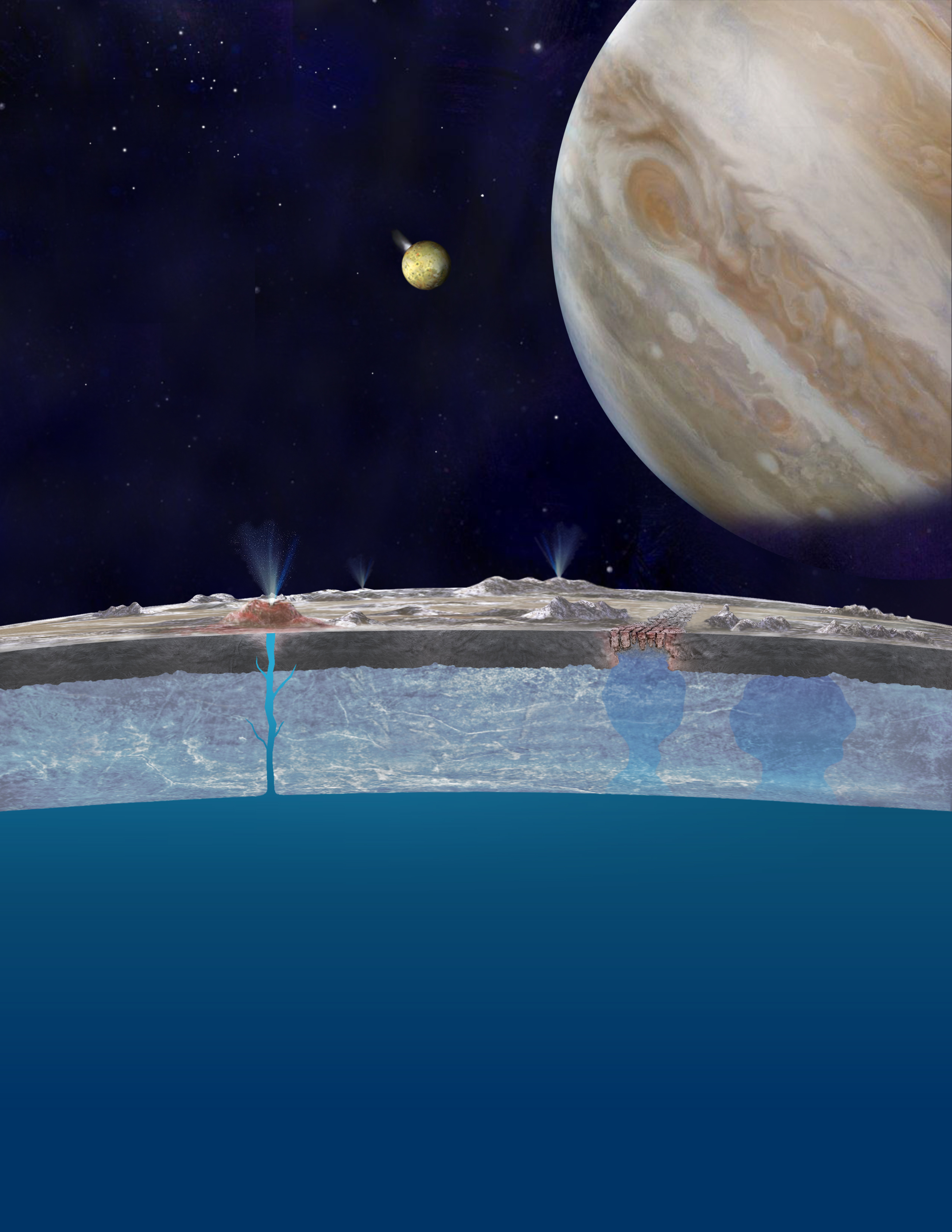
The scientists already have a planet in mind where they think looking for life such as D. audaxviator may be fruitful. That planet is Europa and it is actually Jupiter’s moon. Europa is buried beneath ice, very far from the heat and sustenance given by our sun. But, through logic, deduction, and other data we’ve gathered from studying other elements in our solar system (e.g., meteorites), the scientists believe they can predict with some certainty what they might find on Europa.
Based on Europa’s orbit, the scientists have concluded there is a good chance there is some heat in its oceans. The chemical make-up probably is similar to what we find on Earth, the moon, and on Mars. The presence of vast oceans beneath the ice are also a plus.
 D. audaxviator was found deep under a gold mine in South Africa in samples taken from the groundwater. They discovered it was the only living thing in the water so it was clearly not feeding on anything living.
According to Daniel Galante, “This very deep subterranean mine has water leaking trough cracks that contain radioactive uranium. The uranium breaks down the water molecules to produce free radicals. The free radicals attack the surrounding rocks, especially pyrite, producing sulfate. The bacteria use the sulfate to synthesize ATP, the nucleotide responsible for energy storage in cells. This is the first time an ecosystem has been found to survive directly on the basis of nuclear energy.”

So, it seems that the conditions under which D. audaxviator lives here on Earth may well be replicated, at least closely enough, that something like them could be living on Europa.
Galante added, “The ocean bed on Europa appears to offer very similar conditions to those that existed on primitive Earth during its first billion years. So, studying Europa today is to some extent like looking back at our own planet in the past. …the study is also a gateway to understanding the origin and evolution of life in the Universe.”
NASA learned a lot about Europa when the Galileo spacecraft flew by it and took many readings. They hope to launch a new craft, the Europa Clipper sometime between 2022 and 2025, to learn more about the tantalizing moon.

Aliens
So far, no one is talking about finding the proverbial little green men on Europa, or anywhere in our solar system for that matter. But that doesn’t mean finding tiny little creatures like these bacterium is any less significant.
What’s great about this analysis is that it’s at least giving us a plan how to proceed as we enter new and unknown worlds. Once there, I suspect the scientists will have to think fast to accommodate conditions they may never have considered or imagined, but that’s exactly what exploration is about.
I wish them luck, and in the immortal words of Captain Picard, say “Make it so!”
So, what do you think about life on other planets?

References
https://www.nature.com/articles/s41598-017-18470-z
https://www.sciencealert.com/bacterium-lives-off-nuclear-energy-alien-life-europa