
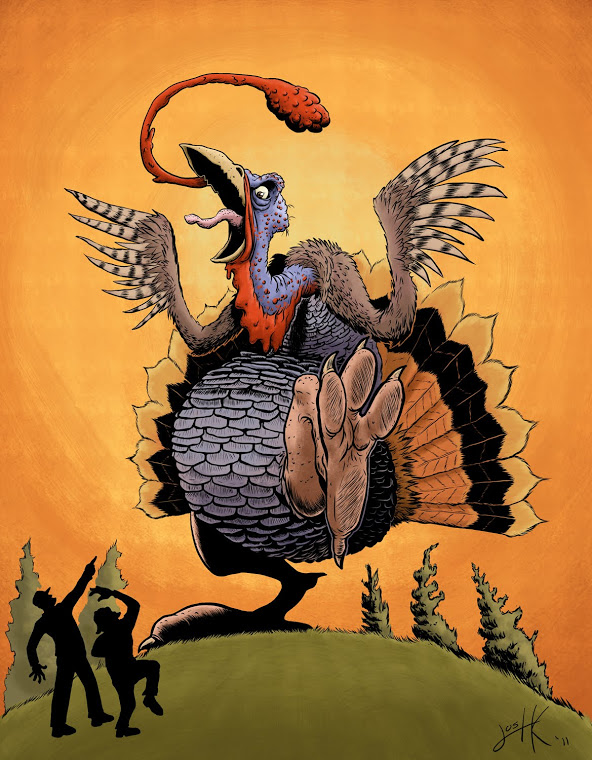
 On this Thanksgiving weekend, CryptoVille revisits the legend of Gobblesquatch, a Thanksgiving cryptid of gigantic proportions! But we also look at its smaller little cousins, the wild turkey to see how strange and cryptid-like they really are.
Meleagris gallopavo, the scientific name for turkey, has been around for many years. We’re not entirely sure how they got their name. Some say the Native American word for turkey was “firkee,” while others say the noise a turkey makes when afraid, “turk turk turk” is how it got its name.
 Another version tells of Christopher Columbus spotting them and thinking they were a type of peacock (because he may have thought he landed in India??), so he named them “tuka,” an Indian name for peacock in India’s Tamil language.
Regardless, turkeys hold the distinction of being the only pure breed of poultry native to the Western Hemisphere.
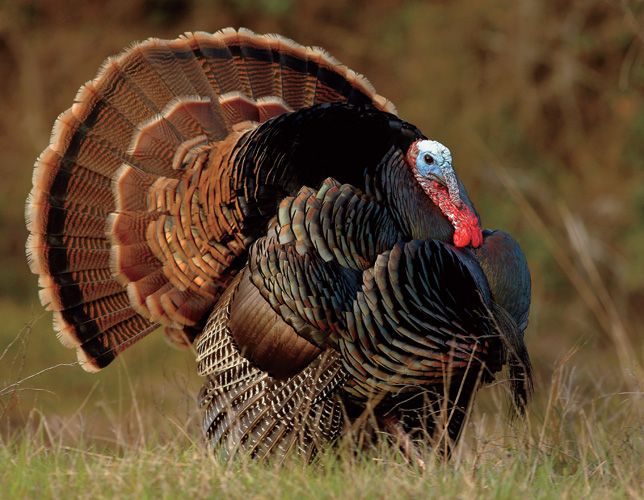 There are six subspecies of turkey. The pilgrims ate M. gallopavo silvestris, the turkey that lives in the Eastern United States (photo right).
M. gallopavo gallopavo is another species that was domesticated by the Aztecs which lives in southern Mexico. The funny thing here is that the Spanish brought this species back to Europe whereupon later pilgrims brought those birds with them back to the New World. So those turkeys went full circle!
 A third species, M. ocellata, called the ocellated turkey lives on Mexico’s Yucatan Peninsula. (For a full description of all six subspecies, see the link in the References section below to the NWTF.)
At one time, rumors said that Benjamin Franklin wanted to name the turkey as our national bird, but ultimately the bald eagle won that battle. One source said that wasn’t true, that he is only credited with praising the turkey for being a respectable bird in a letter to his daughter.
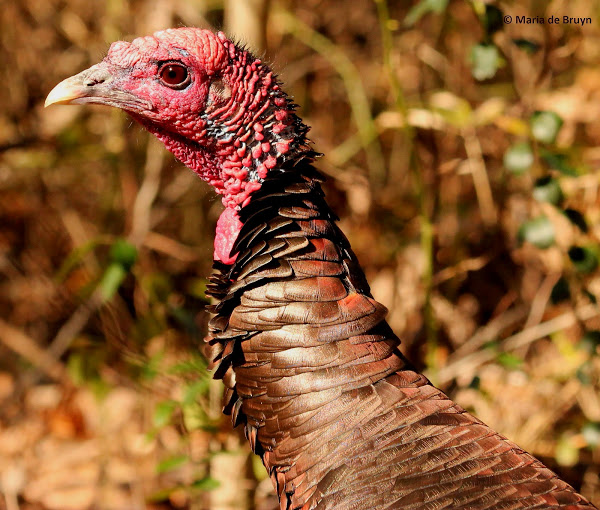 Senses
Although turkeys hear very well, they have no external ears! They can hear sounds up to a mile away.
Despite having eyes on either sides of their heads, they have excellent color vision and their peripheral vision is so good that they usually see anything sneaking up behind them. They can even see two separate objects at once.
Their sense of taste is good. They can detect salt, sweet, acid, and bitter tastes much like mammals do, although turkeys have fewer taste buds than mammals. Their sense of smell is poor which might be a good thing especially on Thanksgiving day!
 Flying High
Wild turkeys are able to fly and they have been clocked at speeds of 55 mph! On the ground they can run 25 mph.
They often roost in trees for the night but spend most of the day on the ground, foraging for food.
Male turkeys are the only ones who gobble.
Appearance
Wild turkeys feathers are dark colored, save for some brighter coloration around the male’s tail feathers. They don’t have the prettiest faces for the following reasons.
Turkeys have fleshy bumps on the head and neck area called “caruncles.” Then there’s the long flap of skin that hangs over their beaks; that’s called a “snood.” Perhaps most obvious is the red skin that hangs in folds on their neck; that is called a “wattle.” None of these are going to win them any beauty contests anytime soon!
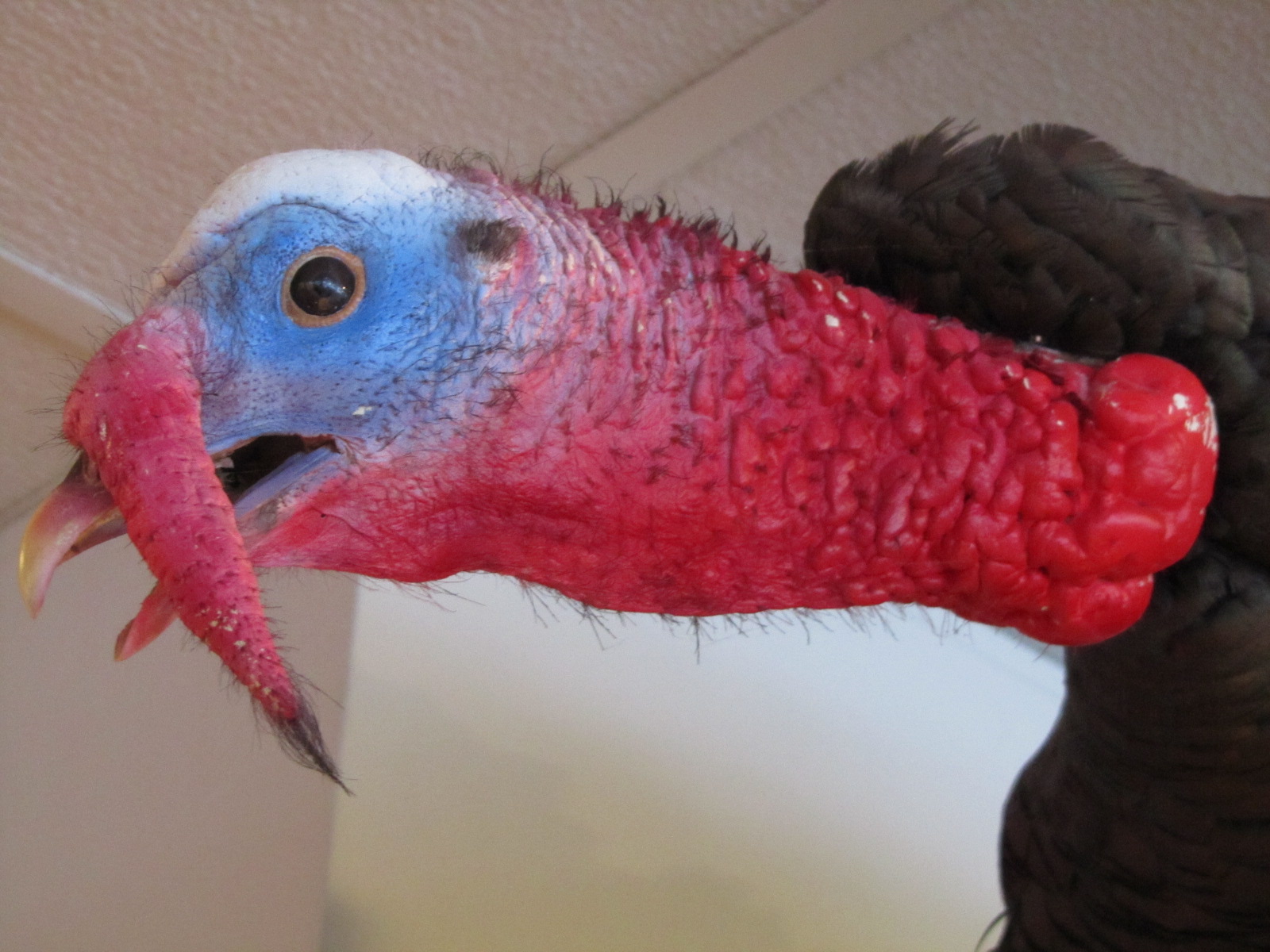 Male turkeys have spurs on their legs which they use during mating season. The length of a male’s snood has been associated with better health. A study done in 1997 and reported in the Journal of Avian Biology reported that female turkeys (hens) prefer males with longer snoods.
Scientists say a turkey’s beak and feet are highly sensitive to touch. They believe this helps them detect and find food sources. Speaking of food, turkeys have stones in their stomachs to aid in digesting the coarser foods they ingest.
Turkey scat is quite distinctive. Males’ droppings are spiral shaped while females’ droppings resemble the letter J. You probably shouldn’t step in either kind.
 Baby Turkeys
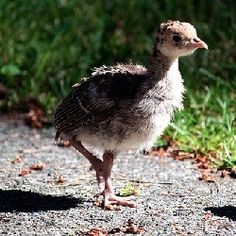
Hens lay eggs for 10 to 12 days, one per day. Then the eggs incubate for nearly a month until they hatch. Babies, called poults, eat little things like bugs, berries, and seeds. Adults eat them as well as larger items like small reptiles and some nuts.
Male turkeys gobble but all turkeys make other noises like “purrs,” “yelps,” and “kee-kees.”
Gobblesquatch
There is another reported species of turkey roaming the woods of North America and this one is called Gobblesquatch! It pretty much stays in hibernation until late Fall when it starts to roam the woods seeking revenge for its cousins who mercilessly appear on 95% of America’s Thanksgiving tables!
For more information about that monster of a creature, see CryptoVille’s report here:
https://visitcryptoville.com/2013/11/28/gobblesquatch-legendary-creature-or-holiday-hoax/
 Happy Thanksgiving
I just want to take a moment to thank my readers who stop by and visit CryptoVille regularly, many of whom share their thoughts and experiences with us in the comments section. Without you, I would just be talking to myself and feeling a bit lonely.
Thank you for your time, your support, and your kindness!
Wishing you and yours a very Happy Thanksgiving!
References
http://www.infoplease.com/spot/tgturkeyfacts.html
http://biology.about.com/od/birds/a/turkey_facts.htm
http://www.smithsonianmag.com/science-nature/14-fun-facts-about-turkeys-665520/?no-ist
http://www.nwtf.org/hunt/article/wild-turkey-subspecies
[…] heard was that Benjamin Franklin allegedly wanted the bird as our national bird. According to the Cryptoville website, that was only an exaggeration based on Franklin saying he liked the bird. Cryptoville is […]
[…] heard was that Benjamin Franklin allegedly wanted the bird as our national bird. According to the Cryptoville website, that was only an exaggeration based on Franklin saying he liked the bird. Cryptoville is […]